Table of Contents
ToggleA cramped kitchen can drain your motivation faster than a dull drill bit. Whether you’re working with a 70-square-foot galley or a cozy studio layout, small kitchen furniture is where smart design meets everyday function. The right pieces won’t just fit, they’ll work harder, look better, and make your morning coffee ritual feel less like an obstacle course. This guide walks you through practical solutions that actually fit your space, from drop-leaf tables to rolling carts that earn their floorprint.
Key Takeaways
- Small kitchen furniture must serve multiple functions—a bench with storage, drop-leaf table, or rolling cart can replace several single-purpose pieces and reclaim valuable floor space.
- Drop-leaf and expandable tables are ideal for compact kitchens, collapsing to 12–18 inches deep when not in use and accommodating four to six people when fully extended.
- Vertical storage solutions like wall-mounted cabinets, pegboards, and tall narrow shelving maximize limited square footage without consuming precious counter or floor space.
- Quality matters in small spaces—invest in solid wood and sturdy hardware for furniture that withstands repeated use, and avoid particleboard that sags under weight.
- Rolling carts and movable units offer flexibility by tucking away during meal prep and repositioning as needed, making them essential multi-functional pieces for tight layouts.
- Proper measurements and placement drive kitchen workflow—ensure 28–30 inch work surface heights, maintain 18–24 inches of pathway clearance, and position furniture to avoid blocking the natural path between fridge, stove, and sink.
Why Small Kitchen Furniture Matters
Small kitchens don’t need small thinking, they need smart furniture choices. When every square foot counts, pieces that pull double duty become non-negotiable. A standard rectangular dining table might claim 40 square feet of floor space: a drop-leaf alternative can shrink to 15 when closed. That difference between cramped and comfortable often hinges on furniture scale and function.
Building code doesn’t dictate furniture size, but human ergonomics does. Work surfaces (countertops, tables) should sit 28–30 inches high for comfortable prep and dining. Pathways through your kitchen typically need 18–24 inches of clearance for safe passage with items in hand. Oversized furniture eats into both.
Small kitchen furniture also affects workflow. If your island, table, or cart blocks the natural path from fridge to stove to sink, you’ll feel it every time you cook. Conversely, pieces positioned thoughtfully can create storage without stealing usable counter space, a genuine win in compact layouts.
Multi-Functional Tables and Seating
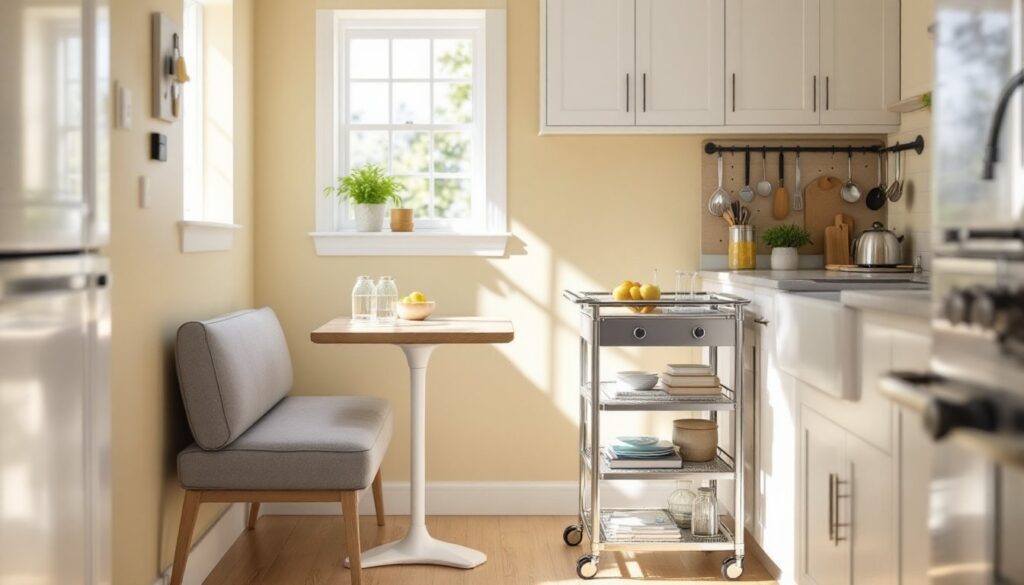
In a small kitchen, a table that only seats and does nothing else is wasted real estate. Multi-functional tables combine dining, prep space, and sometimes storage in one compact footprint. A 36-inch round pedestal table fits two to four people and takes up less visual real estate than a square with legs at each corner. The pedestal base also leaves more legroom underneath.
Consider a console table behind a bar-height counter or against a wall. At 12–16 inches deep and 40–48 inches wide, it provides prep surface without claiming floor space during meal prep. Some designs include lower shelves for cookbooks or small appliances. Wall-mounted drop-leaf tables fold flat against the wall when unused, ideal for galley kitchens where counter depth is already tight.
Bench seating with storage underneath combines seating, dining, and hidden organization. A 48-inch upholstered bench can hide 10–15 cubic feet of cookware, linens, or small appliances. Pair it with a small table on casters (wheels) and you’ve got flexible dining that shrinks or expands as needed.
Drop-Leaf and Expandable Options
Drop-leaf tables are classics for a reason. When both leaves are up, a 36–42-inch model seats four to six. Fold one or both leaves down, and it becomes a 12–18-inch-deep side table that hugs a wall. Look for solid wood or veneer over plywood cores, avoid particleboard, which sags under repeated leaf expansion and weight. Hinges matter too: quality drop-leaf hardware from manufacturers like Rockler or Lee Valley costs more upfront but won’t loosen after 100 uses.
Expandable tables with butterfly leaves or sliding tops offer another approach. They stay compact (often 30–36 inches wide) until you need length. A 48-inch butterfly-leaf table expands to 60+ inches in seconds. The downside: you need floor space to pull it open and enough clearance around it when extended. In a truly tight kitchen, this only works if you’re willing to move the table aside during prep.
Height and material also matter. A 30-inch-tall table works better in tight spaces than standard 30-inch dining height for prep and casual seating. Light finishes (whitewashed oak, natural maple) make small spaces feel airier than dark stains. Living Room Furniture Sets often use these same strategies to maximize perceived space, principles that translate directly to compact kitchens.
Smart Storage Cabinets and Shelving
Wall-mounted cabinets and shelves are the vertical answer to horizontal space constraints. A 12-inch-deep wall cabinet above your counter adds cubic footage without eating floor space. Standard cabinet depth runs 10–12 inches: go deeper and you’ll clip your head while standing at the counter. Open shelving (often 8–10 inches deep) feels lighter visually but requires discipline to keep clutter-free.
Cabinetry should fit your actual layout. Pre-assembled or semi-assembled stock cabinets (from IKEA, Home Depot, or Lowe’s) come in 3-inch increments: 9, 12, 15, 18, 24 inches wide. Custom cabinetry is prettier but often unnecessary in a small kitchen, good stock pieces, properly installed and finished, look built-in without the cost. Budget $150–400 per linear foot for stock: semi-custom runs $400–800: full custom exceeds $1,000.
Installation matters. Cabinets must attach to wall studs (typically 16 inches on center) with 3-inch cabinet screws, not drywall anchors. Skipping studs means sagging, which turns a $500 cabinet investment into a safety hazard. If studs don’t line up with your desired placement, blocking (2×4 lumber secured between studs) solves it.
Corner cabinets are notorious for wasted space. A lazy Susan or pull-out carousel reclaims 60–70% of that awkward corner, worth the $80–150 retrofit. Vertical dividers inside cabinets corral baking sheets and cutting boards so they don’t topple. Small touches, big impact.
Resources like The Kitchn and Homedit offer real-world small kitchen storage ideas that go beyond generic advice.
Vertical Storage Solutions
Vertical storage is your best friend in tight quarters. Wall-mounted pot racks, magnetic strips for knives, and pegboards eliminate the need for deep drawers and bulky racks on countertops. A magnetic strip (16–24 inches) costs $15–40 and frees up a drawer. Pegboards with hooks let you organize utensils and small tools visually, and they’re easy to adjust as needs change.
Tall, narrow shelving units (8–10 inches wide, floor to ceiling) fit into corners or unused wall space. A 72-inch-tall unit might hold as much as two wall cabinets while taking up only 80 square inches of floor footprint. Use closed shelving on the bottom (less visible clutter) and open shelving on top (lighter visual weight).
Pull-out pantry cabinets, tall, narrow sliding units that tuck beside the fridge or into a gap, maximize dead space. A 9-inch-wide pull-out holds 40+ cans or jars. They’re standard in modern semi-custom lines and can be retrofitted into older kitchens if you have the wall depth. Installation costs vary ($200–600 labor plus materials), but the usable storage gain justifies it for many small kitchens.
IKEA hacks dominate small kitchen solutions. Small kitchen ideas on IKEA Hackers show how their modular shelving and cabinets can be combined and modified for non-standard layouts, a practical resource if you’re comfortable with basic carpentry.
Rolling Carts and Movable Units
A rolling cart is the Swiss Army knife of small kitchen furniture. At 24 inches wide and 15 inches deep, a 3-shelf cart fits between cabinets, against a wall, or beside your main work surface. When you need counter space for meal prep, roll it aside. When you need extra storage or a mobile beverage station, it’s right where it lives. Metal frames outlast plastic: ball-bearing casters (wheels) roll smoother than cheap rubber ones.
Bar carts add style and function. A 24-inch-wide cart can hold coffee mugs, spirits, a hot water kettle, and drinking glasses in a vertical footprint that takes up maybe 4 square feet of floor space. Position it in a corner or against an underused wall section. It’s movable, doesn’t require installation, and visually defines a small space without making it feel cluttered.
Small rolling islands (24–30 inches wide, 18–24 inches deep) work in open-plan kitchens with slightly more room. A solid wood or butcher-block top provides prep surface: undershelves hold cookbooks or small appliances. Quality versions run $200–600: budget lines start around $100 but won’t last through heavy daily use. Make sure the caster locks are firm, a rolling island with shifty casters is a safety issue and a constant annoyance.
When choosing any rolling unit, test the wheels in person if you can. Casters rated for at least 75 pounds per wheel are standard: larger carts need heavier-duty hardware. Locking casters (brakes) are essential if you have kids or uneven flooring, a cart that drifts during prep is more liability than asset.
Materials matter: stainless steel or powder-coated steel frames resist moisture better than plastic or particle board. If you’re in a humid climate (coastal, tropical, or high-moisture environments), avoid untreated wood carts, they’ll warp or mildew within a year.
Conclusion
Small kitchen furniture succeeds when it earns its space. Drop-leaf tables fold away, rolling carts tuck into corners, and wall-mounted storage climbs toward the ceiling instead of spreading across the counter. Measure your kitchen, understand your actual workflow, and choose pieces that do more than one job. The goal isn’t designer perfection, it’s a functional, comfortable space where cooking and gathering actually work.