Table of Contents
ToggleA large living room is both a blessing and a challenge. Plenty of square footage sounds great until you’re standing in the middle of an empty, echoing space wondering how to fill it without making it feel like a furniture showroom. The trick isn’t buying bigger, it’s understanding how scale, proportion, and strategic placement work together. Whether you’re furnishing a brand-new space or reimagining one that feels off, this guide walks you through the fundamentals of styling large living room furniture to create a room that actually feels like home. You’ll learn what pieces matter most, how to arrange them, and which design principles keep everything from looking sparse or cluttered.
Key Takeaways
- Large living room furniture should command at least 30-40% of the floor area when arranged to avoid a sparse, disconnected feeling.
- Choose oversized sofas and sectionals in the 96- to 120-inch range paired with accent pieces rather than relying on a single monolithic item.
- Float your large living room furniture away from walls to create intentional conversation zones and improve traffic flow throughout the space.
- Layer your design with multiple light sources, textures, and colors—neutral bases paired with throw pillows, rugs, and artwork prevent the room from feeling cold and staged.
- Use substantial coffee tables (48 by 28 inches or larger) and entertainment centers spanning 60-80% of the wall width to match your seating’s visual weight.
Understanding Scale and Proportion in Spacious Living Rooms
In a large room, standard furniture can vanish. A typical 84-inch sectional that dominates a modest living room might look undersized in a space that’s 20 feet across. Scale is about matching furniture size to the room’s dimensions: proportion is about how pieces relate to each other.
Start by measuring your room’s length, width, and ceiling height. A living room larger than 20 by 16 feet needs furniture that commands the space. Your main seating should occupy at least 30-40% of the floor area when arranged, anything less creates distance and disconnection. If your ceilings are 10 feet or higher, low, sleek furniture emphasizes emptiness: consider pieces with visible legs but substantial height in the backrest or arms.
Another principle: multiple smaller pieces often work better than one monolithic item. Instead of a single enormous sofa, consider pairing a large sectional with accent chairs or a loveseat. This layering creates visual interest and makes the room feel intentional rather than like one piece was just plopped down. When evaluating whether large living room furniture works in your space, use the rule of thirds, divide your room mentally into zones, and anchor each zone with furniture that’s proportional to that area.
Essential Large Furniture Pieces To Consider
Oversized Sofas and Sectionals
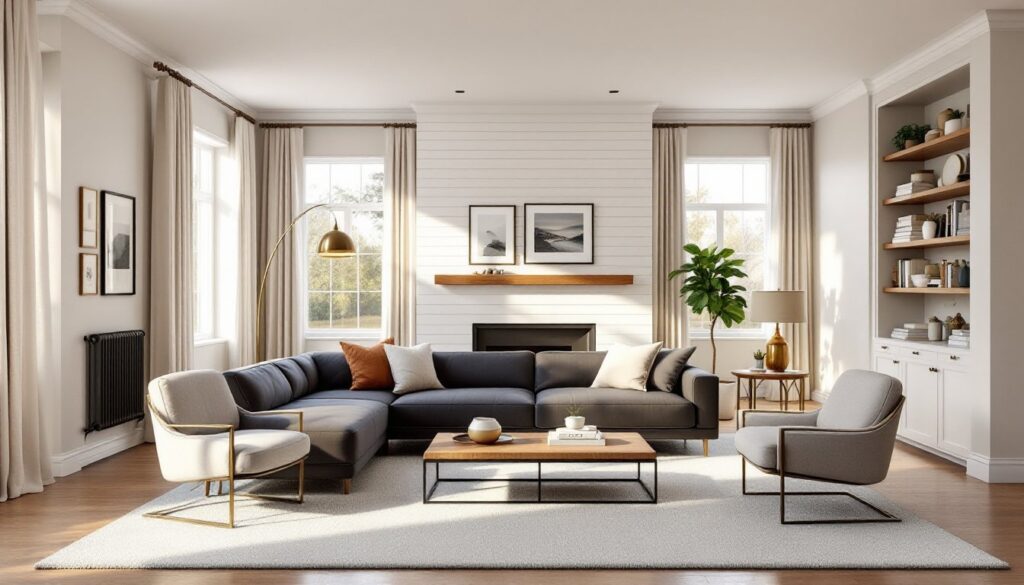
An oversized sofa or sectional is almost always the starting point. Look for pieces in the 96- to 120-inch range: anything smaller often underwhelms in large rooms. Sectionals are particularly smart for spacious living rooms because they define zones and provide ample seating. A U-shaped or L-shaped sectional can anchor one corner or wall while keeping traffic flow open.
Consider the depth: a 40-inch-deep seat is comfortable for lounging but eats floor space: a 36-inch depth works well for larger rooms where you still want to walk around. Fabric matters too, performance fabrics resist stains and wear better than delicate upholstery in high-traffic areas. Leather or microfiber are practical choices. If you’re drawn to statement pieces, living rooms with black couches work beautifully in modern and transitional spaces, though a deep gray, navy, or warm taupe are safer long-term choices.
Statement Coffee Tables and Entertainment Centers
A coffee table in a large room should be substantial. A 48- by 28-inch top is standard: anything smaller looks timid. Wood, metal, or glass-topped tables with sculptural bases add visual weight without feeling heavy. Avoid spindly legs, they make large furniture look fragile.
Your entertainment center (if you have a TV wall) needs to match your sectional’s visual weight. A mounted TV alone looks unfinished: pair it with built-in shelving, a media console, or flanking cabinets that span 60-80% of the wall width. This distributes visual mass and prevents the TV from floating. Consider mixing open shelving with closed storage to avoid a bulky appearance, alternating cubbies and solid panels keeps things feeling balanced.
Layout Strategies for Maximum Impact and Flow
Layout is where many large living rooms fall flat. A common mistake is pushing all furniture to walls, which makes the room feel hollow and unused. Instead, float your seating, position sofas and chairs to create a distinct conversation zone, even if it’s not centered.
Start with your focal point. This might be a fireplace, a bank of windows, or your TV wall. Angle your primary seating (sectional or sofa) to face this focal point, then add complementary pieces around it. Accent chairs and side tables don’t all need to touch the sofa: let them breathe. A gap of 18-24 inches between pieces feels open without being sparse.
Traffic flow matters in large rooms. Identify natural pathways from entry points to other areas, and don’t block them with furniture. Your seating arrangement should frame these paths, not impede them. If your living room connects to a kitchen or entryway, arrange furniture in an arc or partial circle to create a natural edge that says “seating zone” without walls.
For rooms with multiple zones (like a seating area and a reading nook), use area rugs to define territories. A large room can handle two coordinating rugs of different sizes. Rugs ground furniture and make conversation areas feel contained. For a 20-by-16-foot space, a 9-by-12-foot rug under your main seating works well: a smaller 5-by-8-foot rug can define a secondary space. Modern design inspiration from design magazines often showcases layered rugs and offset arrangements that work beautifully in spacious homes.
Balancing Large Furniture With Design Elements
Large furniture needs support from surrounding design choices. Without them, even quality pieces feel stranded. Lighting is critical, a single overhead fixture isn’t enough. Layer your lighting: a statement floor lamp beside the sofa, table lamps on accent tables, and perhaps a hanging pendant or chandelier to add height and visual interest. Large rooms benefit from uplighting (floor lamps pointing up) to fill the visual space above furniture.
Color and texture prevent a room from feeling cold and empty. While neutral base colors (whites, grays, warm beiges) provide calm, add depth through throw pillows, blankets, and area rugs. A monochromatic room with only large furniture looks staged: texture, wool, linen, leather, tactile fabrics, brings warmth. Consider accent walls or gallery layouts to break up expanse of blank wall behind or beside your seating.
Storage and secondary pieces serve double duty. Open shelving, bookcases, console tables, and media cabinets add visual divisions without closing off the space. These pieces also provide spots for decor, framed photos, plants, artwork. A formal living room often uses architectural elements like molding, wainscoting, or built-ins to add structure, while more casual spaces rely on furniture arrangement and layered textiles.
Don’t forget vertical elements. Tall artwork, floor-to-ceiling curtains, or vertical bookshelves draw the eye up and make the room feel less horizontal. Incorporating accent chairs in complementary styles adds visual rhythm and prevents the space from feeling monotonous. Luxury and designer furniture works well too, brands showcased on Elle Decor often feature bold, proportional pieces that work beautifully in large rooms.
Conclusion
Styling a large living room boils down to three principles: match scale to space, float furniture to create intentional zones, and layer design elements so the room feels lived-in. Measure carefully, choose substantial pieces, and resist the urge to push everything against walls. A well-styled large living room becomes a destination within your home, a place people actually want to gather. Start with your anchor piece (sectional or sofa), build outward with complementary furniture, and add light, color, and texture to make it yours.